

Passenger Assistance At Malaga Airport
Mobility and special needs assistance at Malaga Airport is provided by an organisation called Sin Barreras. This guide explains everything you need to know about Passenger Assistance at Malaga Airport, including how to book it, who can book it, how to find the meeting points, as well as the pros and cons. We also include information about the Malaga Airport Special Needs Lounge below.
What is “Sin Barreras” Passenger Assistance At Malaga Airport?
This is a free-of-charge service at Malaga Airport to support individuals with reduced mobility or people who require special assistance while travelling through the airport. It’s provided by an organisation called Sin Barreras. They cover:
- Pre-arrival Services – Passengers can request special assistance services in advance of their arrival at the airport.
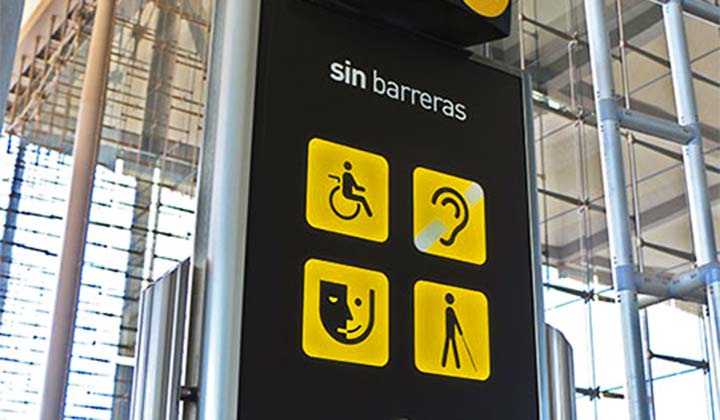
- Meeting Points -There are designated meeting points throughout the airport where passengers with reduced mobility can go to request assistance. These points are clearly marked with yellow signs and operated by staff wearing yellow uniforms. If you cannot find a staff member, you can ring a buzzer for assistance.
- Assistance Staff – Qualified personnel are available to help passengers with mobility issues.
- Equipment – Wheelchairs, adapted transport vehicles, use of lifts, etc.
- Guidance and Escorting – Guiding passengers through airport procedures, helping with luggage, escorting them to the gate, and providing information regarding flights and airport services.
Who is entitled to assistance at Malaga Airport?
- Passengers with limited mobility due to physical or mental disability
- Advanced age
- Any other disability requiring special attention
Please note there are some cases the Sin Barreras service cannot legally accept. For example, they cannot offer guardian or custody services to the following passengers, who must always be accompanied by an adult passenger:
- Minors
- People who are not self-sufficient (e.g.: people with Alzheimer’s disease, etc)
How to Book Assistance at Malaga Airport:
There are 3 steps to book and make sure your trip goes smoothly:
1. Book 48 hours before
Book the Sin Barreras service a minimum 48 hours before your scheduled departure time. If you can, try to book it up to a few days or even a week before to guarantee the best quality of service. You can book the service through their webpage, through the official AENA app, by calling (+34) 91 321 10 00 or by emailing sinbarreras@aena.es.
2. Provide your mobility/disability information
Make sure you provide the correct information about your mobility issue or disability. Without that, Sin Barreras cannot provide you with the correct type of assistance. For instance, the assistance that needs to be given to a blind passenger, a passenger with autism or someone navigating the airport in a wheelchair differs greatly.
3. Meet Sin Barreras at the airport
Go to one of the designated meeting points at Malaga Airport at the time agreed, following all the instructions you’re given. This will ensure the quality of service is at its best. In peak times, go to the airport early if you can.
Meeting Points for Assistance at Malaga Airport
You can find all Sin Barreras assistance meeting points on the AENA interactive Malaga Airport map here. Go into the search panel on the left, and scroll down until you find PRM. Click and the map will show you all the meeting points, information desks and facilities available.
Notifying Your Airline and Destination Airport
Always notify your destination airport and your airline about your disability, mobility or special needs to make sure your trip goes without a hitch. Also, note that some airlines apply transport restrictions on mobility equipment like wheelchairs or electric motorcycles. Always check with your airline first, if you’re bringing your own mobility equipment.
Special Needs Lounge at Malaga Airport
Malaga Airport also has a Special Needs Lounge (you must book it beforehand). This lounge is meant only for passengers with special needs, such as autism or other developmental disorders, or for example, people needing to recharge the batteries of their mechanical prostheses. To access the lounge, you can request it at Aena information points or at the Sin Barreras assistance points. However, its use is subject to availability, so we recommend you book it beforehand by email at agppmr@aena.es.
Malaga Airport Train Accessibility for Wheelchairs
We have been informed by RENFE, the train company, that all the Malaga Cercanias Lines, except for Torremolinos have either a lift, ramp or access for wheelchairs. If you are in doubt you can chat with others here in our Facebook Group The Costa Del Sol Travel Forum.
Our Personal Experience With Sin Barreras Assistance
Recently, my mother had the opportunity to use the Sin Barreras mobility assistance service at Malaga Airport while travelling alone from Malaga to the UK. The experience was fantastic and I wanted to share our story for those who might consider using the service.
(It’s worth mentioning here that my mother had arranged the mobility assistance through her airline when booking her ticket, which meant that the service was already included on her boarding pass. However, if your airline doesn’t offer it, the service can also be booked directly through the Sin Barreras webpage, through the official AENA app, by calling (+34) 91 321 10 00 or by emailing sinbarreras@aena.es.)
I drove mum to Malaga Airport and headed straight for the Departures floor. Right through the main doors, we found the Sin Barreras meeting point easily. There’s seating so you can wait comfortably to be attended to. The staff at the desk were incredibly polite and attentive. They asked for all the necessary details and documents, such as my mother’s passport and boarding pass, and logged her into their system.
After a short wait, they called her by name and brought over the mobility vehicle with a driver. The staff helped her and her luggage onto the vehicle and escorted us to the luggage check-in area. I was allowed to accompany her to this point, as she had specified in her booking that she needed assistance with her luggage. They took us directly to the front of the queue, where the ground staff quickly checked her luggage in.
The next step was Airport Security. At this point, I couldn’t follow her further, but she later told me over the phone that they took her through a different Security entrance, which was much quicker than the regular lines. They then escorted her through passport control, on to her boarding gate, and finally helped her onto the plane.
Regarding Arrivals, my mother also shared how well she had been looked after when she had first arrived in Spain a few weeks before. The Sin Barreras team came onto the plane to assist her, helped her into a wheelchair, and managed all her arrival procedures including passport control and luggage retrieval. They then wheeled her through the arrivals floor to meet us. The exact meeting point can vary –sometimes it’s inside, near the exit doors of the Arrivals hall, and other times it’s outside in the Arrivals courtyard.
In a nutshell, the Sin Barreras service made a huge difference to my mother, as she felt comfortable and safe throughout the journey.
Opinions & Feedback From Member Of Our Group
If you follow our busy Facebook Page, you may have found some posts regarding Assistance at Malaga Airport and generally, the feedback is fantastic. In fact, when walking around the airport, we’ve often noticed how nice and friendly the Sin Barreras staff are. We also interviewed the Sin Barreras staff, who spoke excellent English, and we were very impressed by their professionalism and friendliness. Here are a few typical comments from our community members in our Facebook Group The Costa Del Sol Travel Forum.
Positive reviews:
“We have always had assistance at Malaga airport they have always been helpful and friendly.”
“Used T2 this week, excellent treatment, well done managed to get buggy as 3 of us needed assistance.”
“My mother had pre-booked Assistance for her flight yesterday and it was a treat, everything went well. A big thank you.”
Not-so-great reviews:
A handful of people have mentioned problems with long queues and waiting times. It seems that in peak seasons, the service hasn’t been so great because of this. Therefore, in peak times like summer and Easter, we recommend you book assistance 7 days before you travel and arrive at the Airport earlier than usual.
Top tips: Get the most out of Assistance at Malaga Airport
Be aware that the main Sin Barreras Help Desk in Terminal 3, just by Security, is always the busiest. This area is generally busy and stressful, with people coming in through the terminal main doors, queuing for security and asking airport staff for help. So our advice is to enter via Terminal 2 and just over to the right. There, between T2 and T3, is the main Passenger Assistance Area called Sin Barreras. This area is generally less busy and you won’t have such a long wait.
Complaints
If you need to make a complaint about your booking or if your booking was denied, you can send an email to this address sinbarreras@aena.es. Please be sure to leave reviews especially if the service was just ok or excellent. Sometimes people only leave reviews to complain.
General passenger services at Malaga Airport
Need more information about other services at Malaga Airport? Like medical facilities, pharmacies or anything else? Be sure to visit our full guide to all passenger services at Malaga Airport.
More questions?
If you have questions about Passenger Assistance in Malaga, join our Facebook Group The Costa Del Sol Travel Forum. Our huge community of friendly travellers, used to navigating Malaga Airport, will be happy to help and give you advice. You can also follow us on our Facebook page.
Car Bookings

Advertisement